
Someone asked that I post an account of the ongoing journey that has led to competing in USPSA with my carry gear from concealment.
Heresy, I know. Competing in USPSA, the Gamer Game, with carry gear and concealment? That’s crazy! Yes it is, but also very challenging and rewarding.
I used to just be a tactical guy doing defensive pistol training. Several years ago, my training partners and I thought we were pretty good. We eventually became aware, via informally shooting the IDPA Classifier, that we weren't actually that good – for a long time none of us was even able to shoot Expert.
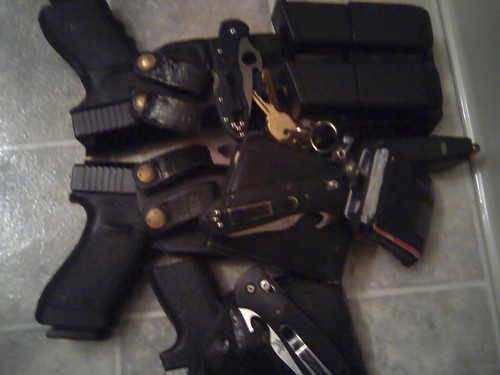
I carried fourteen pounds of gear every day for years and all I got was this Sharpshooter-level score!
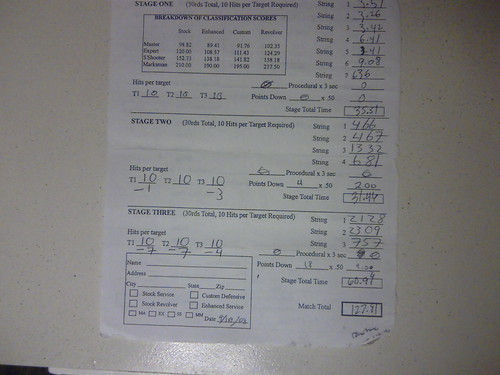
The skill level necessary to score Master or even Expert on the IDPA Classifier was alien to our minds. We had not seen anyone shoot that well, and were only dimly aware that some people could do so. We were insulated and isolated in our little tactical training community and had no real contact with shooters of the higher skill levels found in competitions. We didn't even really think much about competition because even thinking about it would probably get us kilt in da streetz. We just didn't know what we didn’t know.
There's no timer on the street!
But clearly those higher levels of skill were attainable – the score cutoffs were right there in the rankings on the Classifier score sheet. And I thought of how awesome it would be to reproduce master-level performance with my carry gear from concealment.
So a few of us started to practice more than we had been. I started dry firing in earnest, every day, for a few minutes or a few hours. I was using a challenging trigger at the time – the NY1 with standard connector – trying to find out if Mas Ayoob was right that a heavy trigger could be run just as well as lighter trigger. I didn’t end up in precise agreement with him, but after a month of pressing that 10.5 lb. trigger, I had taken around twenty seconds off my Classifier time through increased accuracy and had almost reached the Master class cutoff.
Did some work, realized some benefit, and it made me want to do more.
Over the next few years, I practiced and practiced and practiced. At some point I switched from strong side IWB to AIWB carry, first using a modified Blade-Tech Nano, then later the most excellent Keeper, made by TPI brother Prdator, owner of Keepers Concealment. I immediately became addicted to the crazy draw speed that can come from a good AIWB rig.
This… (AIWB)
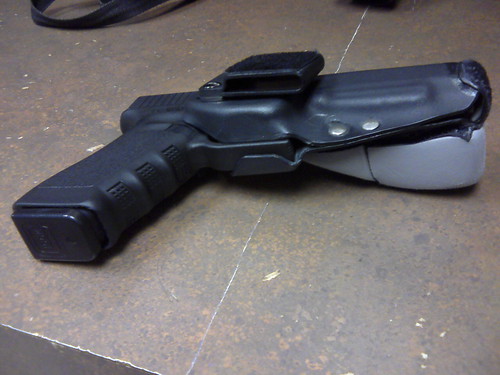
helps me do this…
I came to actually enjoy dry fire. I found that it was not enough to want to hit. I had to learn to enjoy, truly enjoy, that which leads to hitting. I learned to really like drawing the gun and seeing the sights in alignment on target and pressing the trigger. I liked it because it represented hitting. Once I learned to enjoy dry fire, finding time and motivation to dry fire became easy. This was my own realization of focusing on the process rather than on the outcome."
I happened to have the chance to start my competition endeavor with GSSF first and was fortunate to find success right away, which only motivated me more. GSSF is great, but I also wanted to get into more dynamic competition, like IDPA or USPSA.
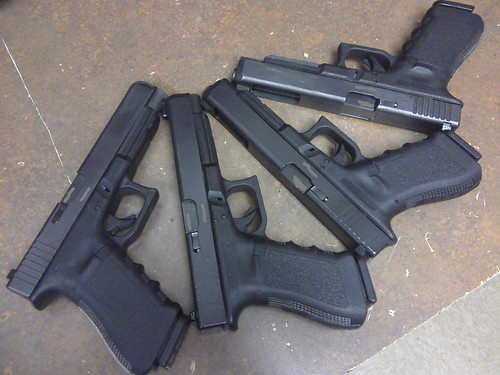
At first glance IDPA seemed like a natural fit. My core interest being self-defense, and my interest in competition being as a way to induce pressure and improve my shooting and gunhandling for self-defense, IDPA seemed like just the competition for me. Yet, in an incredible turn of irony, my real carry gear isn't welcome in IDPA. Appendix carry is not allowed. I would have to wear what amounts to gamer gear for me to shoot IDPA. So, no IDPA for me.
I can't go back to this! I won't!
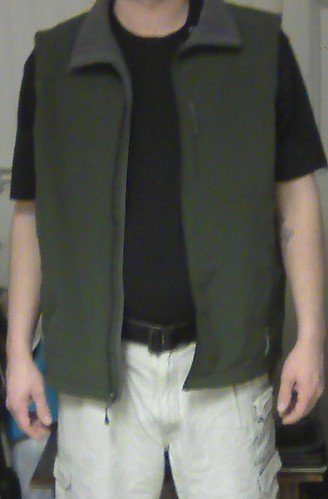
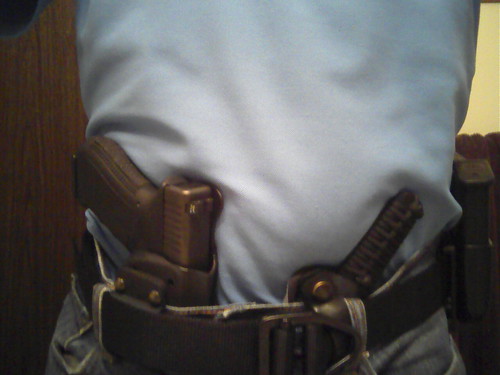
Appendix holsters are allowed in three divisions of USPSA, however: Open, Limited, and Limited-10. I shoot Limited since I judge that division to most closely comport with my carry gear. I can use my real holster, my real mag pouches, my real full capacity magazines, my real clothing, and I don't have to wear any additional mag pouches or anything extra to compete. I just switch out my carry gun for my nearly identical practice/comp gun and I am ready to go. More on that later.
Shooting competition with my carry gear from concealment gives me a lot of confidence. When I leave the match, I leave carrying with me exactly the same potential technical ability that I had during the match.
Dressed for the street and dressed to compete…

This is the gear underneath the t-shirt…
Since I carry a Glock 34 in 9mm, I am shooting Minor caliber in Limited division, which means I get less points per non-A-zone hit and certainly makes placing well more difficult. Concealment makes draws and reloads harder too. So does shooting what is essentially a stock gun in Limited division, where I am up against race guns without the optics and compensators. My gun is not even optimized within Production division rules, which is where my gun actually belongs.
These are the hits I need for a good score. Can’t waste any time getting those hits either...
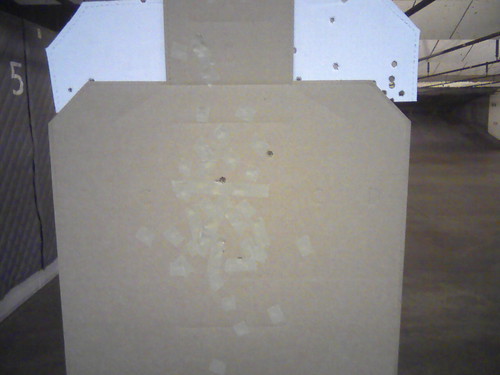
These aggravating factors are not for making excuses about score, but instead exist as positive pressures on my shooting development. I have to shoot A-zone hits. I have to get almost all the points available if I want to do well. I cannot coast on fast C-zone hits with Minor caliber scoring. My draws and reloads have to be that much better to keep up with others’ open-carried race rigs. My shooting has to be that much better to keep up with others in the division. Using a legit carry rig, but being measured against the standards set by the best shooters using the most advantageous gear in the division creates an uphill battle to classify well and that is a big additional pressure for me to be disciplined and shoot accurately at speed.
I can get away with this about once per stage, and sometimes not even that…
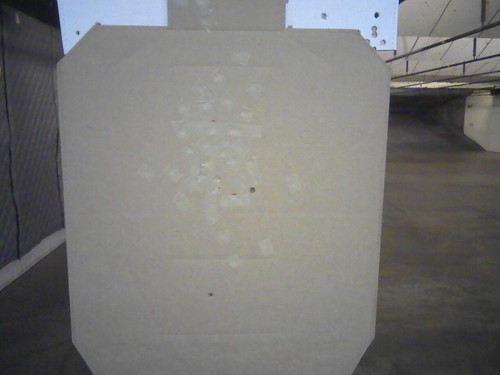
I know that at least a few of the top pro competitors have tried and dismissed shooting Minor caliber in a division allowing Major caliber scoring and remaining competitive at the highest levels. When competitors are that close, the extra points from Major scoring seem to win out. That’s ok. I am not trying to disprove their findings. Simply having the extra pressure imposed on me to shoot good hits with a very low rate of error is hugely valuable by itself.
This will sink my score very quickly.

It has been suggested to me that I ditch the carry gear and concealment, and just put on a gamer rig and shoot Production, which is where my gun belongs. Some have pointed out that the draw is actually a very small part of score in USPSA, and that is true. People have also said, quite correctly, that using a pure game rig during competition will not degrade my skills with concealment gear. No doubt that is true. But I do think that I would be robbing myself of the benefit of drawing and reloading from concealment under match stress."
In my short time in USPSA, I have learned how real match stress is. I am not making a comparison between match stress and the stress of a real violent encounter, but I can unequivocally say that shooting a match is a much more stressful environment for me than simply practicing alone on the range. In my non-going-in-harm’s-way life, match stress is one of the few honestly stressful situations available to me. So I don’t want to miss out on using that environment and pressure to enhance my concealed carry skills.
Slow draw, slow movement, slow makeup shot.....
USPSA is much more complex and mentally taxing than self-defense drills. Drills in self-defense training are very short and simple in comparison to many USPSA stages. The lengthy serial tasking of USPSA is quite demanding compared to what I am used to, and requires a level of mental agility in directing technical skill execution that I had not previously developed. USPSA is hard! Look how much slower and more disorganized I am in a long USPSA course compared to a short drill on the range.
All kinds of errors in this one. Inefficient entries and exits, standing reload, and more…
I’ve seen that, at least at the local level, my carry gear from concealment is very competitive as long as I do my part well. I don’t think the gear holds me back much at all. I've won my division over half the time so far (warning: small sample and local competition only – I hope to get to a couple of major matches in the coming year and see where my gear and skills stand against stiffer competition.)
Gear choice is a big factor in this. I would characterize my stock G34 and the Keeper holster as a "race rig for concealed carry." No doubt things would be much harder if I tried to shoot Limited minor from concealment with, say, a Kahr PM9 (which would be better off in L-10 anyway.) This is just another version of the discussion about doing what’s necessary to carry the most capable equipment that fits into daily life. For me, that’s a concealment race rig and I enjoy the potential technical ability it allows.
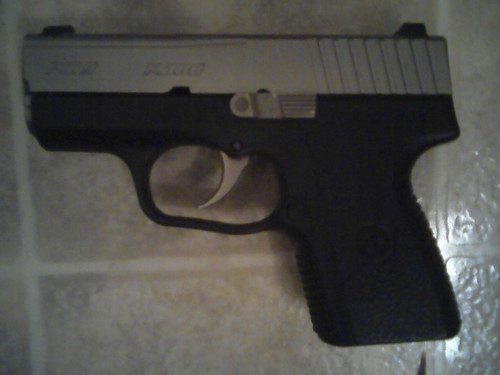
Over the last four years or so, I have done the following to increase my skills: Switched from strong side IWB to AIWB. I saw an immediate improvement to my draw times. When I switched from a modified Blade-Tech Nano to the most excellent Keeper, the consistency of my draw increased noticeably because of the Keeper’s superior ride height options. If you like AIWB and haven't seen the Keeper yet, you should check it out. You can see details of the Keeper in my review here, as well as many others’ positive comments:
I’ve practiced drawing and firing an accurate shot an awful lot. This is probably the skill I have developed the most in the last few years. Speed gains came almost immediately when I switched to AIWB, and since then I have been working to improve accuracy and consistency at that speed. I’ve further explored my old basic four-count draw, the muzzle-level and muzzle-tilted press-outs, the hybrid press-out (arguably what I do now), and even experimented a little with the straight-line competition draw. Before I made a concerted effort to improve my skills, I could draw and shoot an 8” circle at 7 yards in about 1.6 seconds from strong side IWB. I can now do so in around half that time from the Keeper carried AIWB.
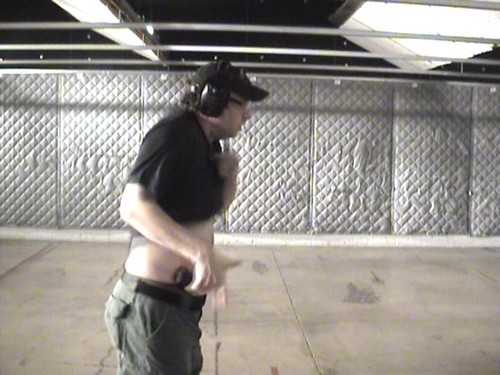
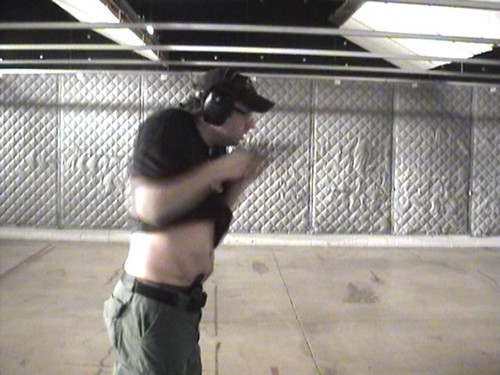
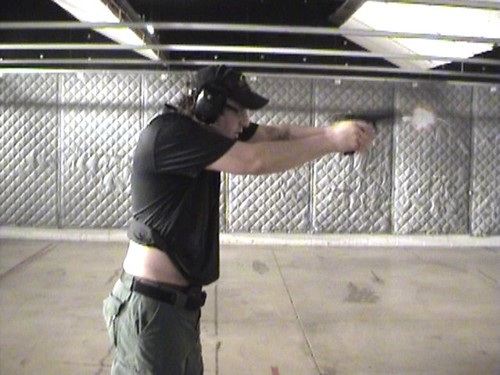
Several drills and standards have served as benchmarks during these last few years and have allowed me to track my progress and recognize tangible improvement. I personally find that important because nothing makes me want to improve more than seeing evidence of improvement. Success begets more and greater successes.
A year and a half ago, I was trying to break five seconds consistently clean on the FAST, and now I’m trying to break four seconds consistently clean.
I tried to get below two seconds on the Mozambique/Failure to Stop, then I started working on beating 1.5 seconds.
Being a little careful.....
Pushing it....
I tried to get below two seconds on the Mozambique/Failure to Stop, then I started working on beating 1.5 seconds.
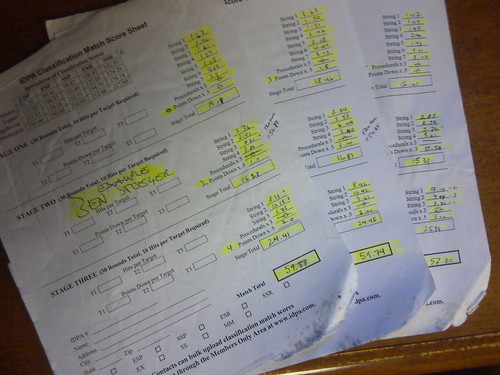
The IDPA Classifier has been the longest-running benchmark of performance I've used. My times have gone from around 160 seconds when I first shot it years ago, down to a current personal best of a little over 72 seconds. Very valuable was finding Dave Sevigny’s, Ben Stoeger’s, and Bob Vogel’s times on the IDPA Classifier and filling out score sheets with their names and their times. All of their scores are a little under 60 seconds. That became a road map to drive toward their skill level on the short drills that make up the Classifier. Over time, the gap between their scores and mine on those short drills has narrowed.
A road map to champion-level performance on short-form drills.
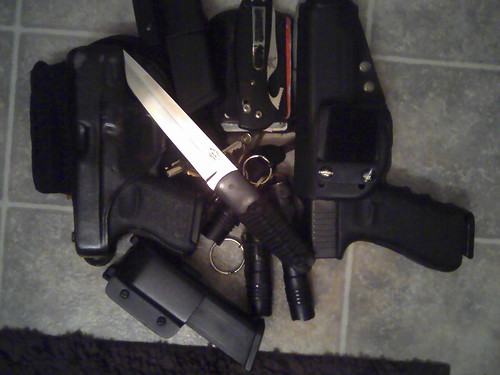
I carry less gear but am much more skillful with what I carry now.....
I’ve intermittently chased a perfect score on the Hackathorn Standards but not made it. I've come close with a 296. Best run on video is a 292. I tend to use the IDPA Classifier rather than the Hack since they are so similar.
292 on the Hackathorn Standards
The Manly Man Hackathorn Standards (Ben Stoeger version) features radically reduced PAR times and is a lot harder. Best on that one is a 274.
252 on the one I recorded.
The Rangemaster Core Handgun Skills Test has been an interesting benchmark because it is scored very differently from the Hack, the IDPA Classifier, and the FAST. It is scored the same way as USPSA, so accuracy and speed are more on an even balance. This run is somewhere between 198 and 209, depending on which is the right way to score it.
Probably the most key thing I have learned to do, that was truly pivotal to all that improvement, was to shift my visual focal depth at will, and without the necessity of a physical object – the front sight – being present. This has allowed me to realize faster and more reliable sight-focused shooting. The specifics of how to do this are a separate discussion, but this single factor has led to a lot of improvement for me because it led to a drastically increased level of visual awareness of the sights and ability to call shots and track my sights.
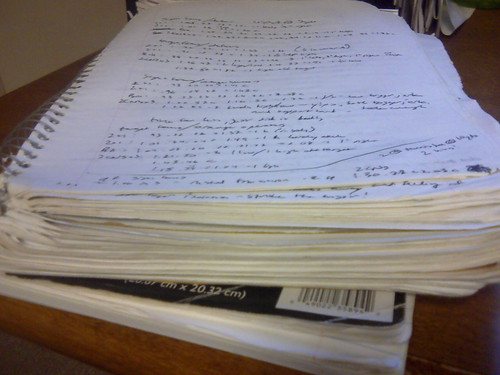
About a year and a half ago, I quit lurking and started posting on Pistol-Forum and then later started a training journal there. I did this to put myself out there and make myself publicly accountable in my practice. You can see my training journal here, which details the last year of practice.
Here is what it looks like before I transcribe it to the electronic training journal.
Todd Green and the Pistol-Forum community’s priority for consistent performance has been an important moderating influence on my need for speed. Todd’s influence was very helpful to me when I hosted his AFHF class last July. He is all about consistency and that’s something I have sorely needed to improve in this ongoing process. Shooting GSSF for about $800 in cash and guns against a national top-20 GM helps a lot too since penalties are huge and bad shots will screw my score big time and rob me of, well...... cash and guns.
Those influences toward consistency were important factors in this success.

The USPSA shooters I’ve met in person and on the internet at Doodie Project have been hugely supportive of my quest to classify and compete using my concealed carry gear. I have yet to face anything but respect, encouragement, and good natured ribbing and discussion. Everyone in the competition community has been way cool to me despite my various tacticalities. They even affectionately challenged me to go head-to-head against an M-class Production shooter in reenacting a scene for the Miami Vice Video Showdown, one of the most amusing things I’ve done this last year.
The original scene from Miami Vice with commentary from the PACT timer company. The Miami Vice part starts at 0:50.
My reenactment. In addition to the funny stuff, the shooting in this video was done in one honest attempt.
Without all the silly theatrics, I tried a second time to improve my score. This is the best of numerous attempts.
In shooting competition to support self-defense training, decisions have to be made about where to retain defensive firearms training doctrine and where it’s reasonable to abandon it. I've kept some elements of my previously-sacred tactical training doctrine and discarded other elements of it.
I'm no longer convinced that overhanding the slide is better than closing the slide using the slide stop lever."
I remain committed to using my carry gear from concealment. A sidenote here: the one and only difference between my carry gun and my practice/comp gun are the sights. The carry gun has night sights and the practice/comp gun has black sights. I haven’t been able to get totally comfortable with black sights on a carry gun, but the black sights are like reverse training wheels – they don’t assist me in disciplined sight-focused shooting – they require disciplined sight-focused shooting and help me ingrain good visual habits.
FULLY BLACK for the visual awareness win!
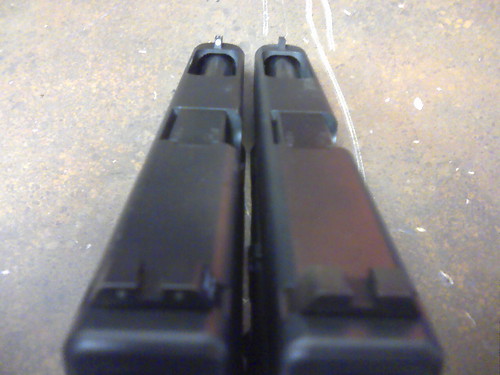
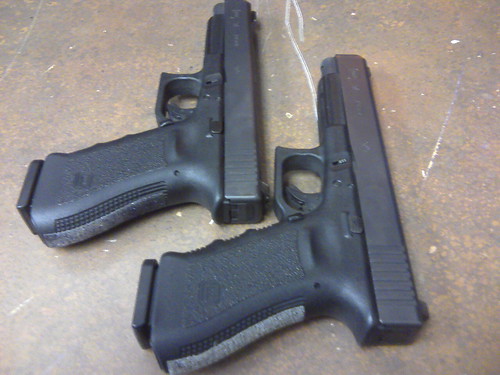
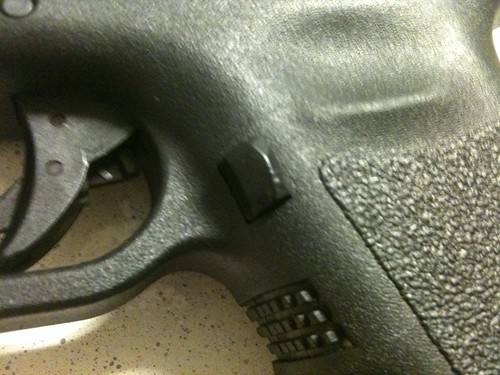
The only non-stock aspects of my pistols are the strip of grip tape on the backstrap, the customized mag catch, and the sights.
I don’t want to sacrifice the no-look reload, preferring to keep eyes on threat/environment. Strangely, I’ve repeatedly failed to perceive the usual increase in reliability of magazine insertion by "looking the mag in." I guess am just weird on this one.
I also prefer to stick with some variation of an inverted-L drawstroke, rather than going to the competition-oriented draw straight from the holster to the final firing position. This is because of the usual self-defense issues accounting for confined-space draws and incorporation of some kind of retention position into the overall drawstroke. And I have become a believer in running the horizontal line of extension at least partially in the true eye-target line.
But competition is just a game! And I’m an odd duck in that game. I'm a little surprised at how comfortable I am being half-in, half-out of the USPSA game. I want to score and place as well as I can. I don't want to compromise certain aspects of defensive technique, as noted above. I want to use my carry gear and concealment even though it puts me at a competitive disadvantage. I have no problem approaching USPSA purely as a game that does not represent reality at all. No game will. I do the walk-through with everybody else, I plan stages and plan reloads, and I make no pretense of tactics or use of cover. I am actually happy at this point that I don't have to deal with rules that require certain tactics be used, which may or may not be valid in any given situation. It’s a game and I play it that way, I just use a certain set of equipment and clothing to play the game with. And that game is very challenging and fun…

My goals in the coming year of USPSA and beyond are to increase my classification and to do well in major matches. I just got my B card in the mail and would like to classify M or GM using my concealment gear. Frankly I was lucky to make B class for my initial classification since I screwed up a couple of classifiers big time. There is undoubtedly a mountain of work needed to reach those goals, but I refuse to believe it cannot be done.
Missed the first shot…This was almost a D-class run. USPSA is not easy!
Anyone who carries AIWB and wants to get the benefits of competition using their concealed carry gear should consider USPSA. I’m only a short distance into the journey and it is a ton of fun and has been a powerful force motivating me to improve.
One year update:
It's been just about a year since I started this thread, and have been continuing to shoot USPSA, albeit less than I would like to. Work and family demands increased partway through last year and I have been struggling to make it to one match per month.
I'm still shooting USPSA the same way and really enjoy it. No plans to change equipment. Sights remain the only equipment I really experiment with very much. I did go from a plain black front to a FO (Fiber Optic) front sight, which I really like, and doesn't seem to be undermining my visual discipline. I think all the time with black sights was really important for me.
The one technique change I made last year was to start looking the magazine in on reloads. What it took for me to see the benefit of doing so was being driven under a lot of time pressure to reload faster in some of the dry fire drills in Ben Stoeger's dry fire book.
Advancing in classification is happening, slowly - I managed to move up to A class toward the end of 2013, and I'm sure excited about continuing to build skill, learn to apply it under match conditions, and move up further in classification.
The next few months of 2014 are getting full fast. Not directly related to USPSA, but it looks like I will have the good fortune to attend the Rogers Shooting School in April, which I am really looking forward to. I' m retaking Ben Stoeger's USPSA class in May, since he's going to be out here where I live. I'm hoping to further my understanding of USPSA. I suspect this is one of the those classes where I will learn more the second time though that might have gone over my head the first time. And my biggest USPSA match to date is coming up a little later in May - the Area One Championship. I can't wait!
Video is a good way to see where I am right now. Shot a local match last Saturday. I screwed up a little here and there - a few Cs, a few extra shots, a few slightly bobbled stage plans, shot too carefully in one instance. But no penalties or gross errors. I got beat by a Limited M, an Open M, and an Open GM. I feel like I shot a pretty good match for me, but am kicking myself for losing the Limited match by 0.016%. I was 2nd overall in Limited, 4th overall in the Combined standings.
It's been just about a year since I started this thread, and have been continuing to shoot USPSA, albeit less than I would like to. Work and family demands increased partway through last year and I have been struggling to make it to one match per month.
I'm still shooting USPSA the same way and really enjoy it. No plans to change equipment. Sights remain the only equipment I really experiment with very much. I did go from a plain black front to a FO (Fiber Optic) front sight, which I really like, and doesn't seem to be undermining my visual discipline. I think all the time with black sights was really important for me.
The one technique change I made last year was to start looking the magazine in on reloads. What it took for me to see the benefit of doing so was being driven under a lot of time pressure to reload faster in some of the dry fire drills in Ben Stoeger's dry fire book.
Advancing in classification is happening, slowly - I managed to move up to A class toward the end of 2013, and I'm sure excited about continuing to build skill, learn to apply it under match conditions, and move up further in classification.
The next few months of 2014 are getting full fast. Not directly related to USPSA, but it looks like I will have the good fortune to attend the Rogers Shooting School in April, which I am really looking forward to. I' m retaking Ben Stoeger's USPSA class in May, since he's going to be out here where I live. I'm hoping to further my understanding of USPSA. I suspect this is one of the those classes where I will learn more the second time though that might have gone over my head the first time. And my biggest USPSA match to date is coming up a little later in May - the Area One Championship. I can't wait!
Video is a good way to see where I am right now. Shot a local match last Saturday. I screwed up a little here and there - a few Cs, a few extra shots, a few slightly bobbled stage plans, shot too carefully in one instance. But no penalties or gross errors. I got beat by a Limited M, an Open M, and an Open GM. I feel like I shot a pretty good match for me, but am kicking myself for losing the Limited match by 0.016%. I was 2nd overall in Limited, 4th overall in the Combined standings.


 with orange outline front. New

